Protect What Matters Most & Live Your Best Life
TLB Planning for Secured Financial Future
Good planning requires that when client is still able; such as, individual, family or business leaders should estimate the amount of income they will need to live a comfortable lifestyle allowing them to do whatever they and their family, spouse and business leaders want to do. Are they going to want an extravagant lifestyle? Or are they going to want a somewhat comfortable lifestyle? We can help by assuring them that TLB can help them realize some of the dreams they hold for the rest of their life.
Income from an TLB occurs as;
1. Accelerated Living Benefit: the insured experience a qualified illness condition
2. Compensation Method: The policy owner chooses to either fully surrender or sell the policy
3. Death Benefit: The beneficiary is getting the death benefit after the insured has died.
1 Accelerated Living Benefits
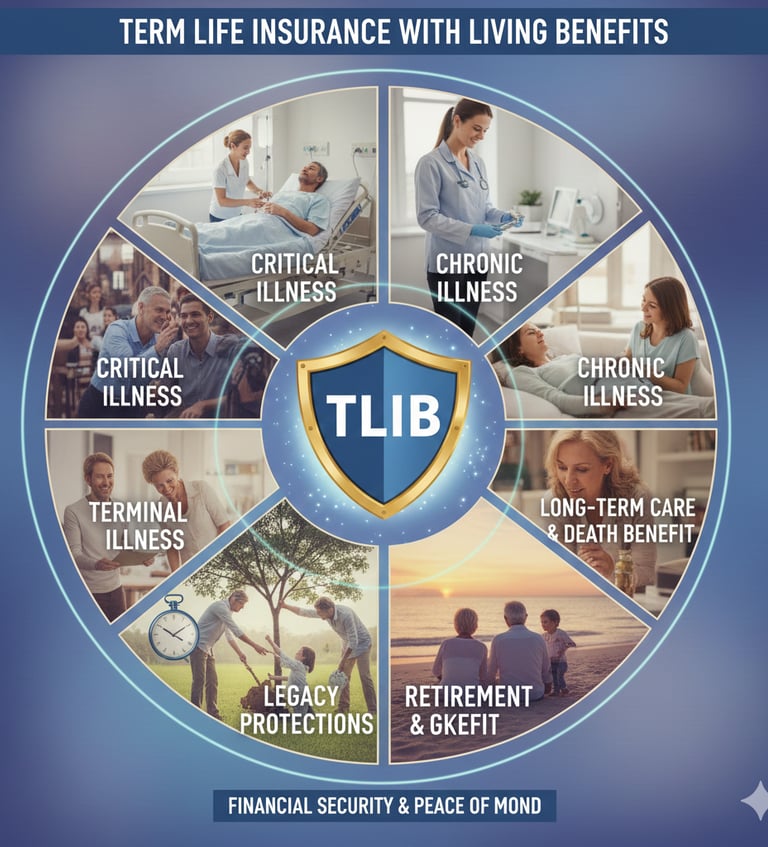
An accelerated benefit rider can be included in an TLB insurance policy when it is created and the money can be used by the client in the event of a qualified unexpected illness diagnosed as either terminal, critical such as cancer, stroke, major organ transplant, heart disease, etc, or as a chronic condition, such as diabetes or severe osteoarthritis. The proceeds are income tax free; and
NOTE: You will have to read your policy to see how different diseases are classified, since companies differ in how they treat payments.
Accelerated Benefits Origination
Accelerated benefits were first developed in Canada when an executive of the Prudential Insurance Company subsidiary saw the need for such an arrangement as a result doing volunteer work in an AIDS/hospice facility. After observing those with greatly diminished life expectancies, and their increased need for cash to pay for their LTC, the executive saw a way to provide a little relief. The Prudential Insurance Company deserves great credit for bringing this concept to the U.S., paying the expenses to get the U.S. tax laws changed, and getting favorable rulings from the IRS.
Accelerated Benefits Qualifications A doctor or some other approved professional must certify that the condition is either Terminal, Critical or Chronic, and the company will decide based on the claim if the condition qualifies for acceleration of the death benefit.
Some policies will accelerate a benefit on a policy if the insured has been confined to a nursing home for a period of six months before applying for the benefit. If this is the case, the policy will usually pay out 2% of the face amount each month with the check going to the nursing home.
For example, if you have a $1,000,000 policy, the insurance company will send $20,000 a month to the nursing home to be used to pay the costs of being a resident. The following are some concerns about this accelerated benefits scenario:
If the face amount of the policy is $1,000,000, the policy proceeds will be exhausted in 50 months;
If the average cost of a nursing home is $20,300 a month, there would still be a need to supply the remaining $300 from other assets;
If the death benefits are needed for another reason, this option cannot be used; and The $2,000 a month in the above example is impacted by future inflation.
Accelerated Benefits Conditions
A: Terminal Illness
HIPAA says a person is terminally ill when the length of time the person has left to live is 24 months or less, as determined by a health care practitioner. The shorter the time frame a person is expected to live, the higher percentage of money that will be paid.
B: Critical Illness or Critical Injury
A Life Insurance policy with Living Benefits for Critical illness: An insurance policy that pays a face amount, usually as a lump-sum payment, if the insured is diagnosed with a specified critical illness. This sum is paid directly to the insured regardless of any other sources of income or any incurred expenses. There is a survival period that must be passed after the diagnosis to qualify for a benefit payment;
Qualifying Critical illnesses include: Cancer, Stroke, Heart Attack, Aplastic Anemia, Cystic Fibrosis, End-Stage Renal Failure, Heart Valve Replacement, Sudden Cardiac Arrest, Motor Neuron Disease, Major Organ Transplant, etc.
Covered Critical Injuries Include: Coma, Paralysis, Severe Burns, Traumatic Brain Injury.
C: Chronically Ill Diagnosis
A Life Insurance policy with Living Benefits that include Chronic illnesses: An insurance policy that pays a face amount, usually as a lump-sum payment, if the insured is diagnosed with a specified critical illness. This sum is paid directly to the insured regardless of any other sources of income or any incurred expenses. There is a survival period that must be passed after the diagnosis to qualify for a benefit payment;
Qualifying Chronic Illness: If you become cognitively impaired or if a doctor certifies you can’t independently perform two of these six ADLs; Batting, Eating, Dressing, Toileting, Continence, and Transferring. The insured is diagnosed as chronically ill, means the person is unable to perform at least two of the ADLs. The period of time required for assistance with ADLs is 90 days without substantial assistance.
A True Story
A family called and informed their agent of their dire situation, which concerned their son who was suffering from a terminal illness. The agent contacted the insurance company with an TLB policy with living benefits for their son. The accelerated benefit rider for the policy was activated. They further allowed the family to access 50% of the face amount of the policy. The family chose to accelerate the benefit and take the check for half (50%) of the face amount. When the check arrived, it was used to find exotic cure, treatment and other needs.
Compensation Methods
a: Fully Surrendering the Policy
The insured has another option, referred to as surrendering the policy. Using the same numbers as before, the owner can surrender the policy, and the company will send the money. The policy will be terminated, and the owner could take the money and then use to find exotic cure, treatment and other needs and live happily ever after.
Consequences of Surrendering the Policy
The upside is that the owner will get a lump sum of huge amount of money, no further payment of premiums will be required and there is no loan to be repaid. The downside is if the cure doesn’t work. How much will the beneficiaries receive upon the insured’s death? Since the policy was surrendered, they receive nothing.
b: Selling the Policy
There is another option, and that is to sell the policy to a viatical settlement company. The viatical company will pay the insured some percentage of the face amount (say $1,000,000), which obviously would be higher than the accumulated cash value of the policy.
A viatical settlement is an agreement by which the owner of a life insurance policy receives compensation for less than the expected death benefit of the policy in return for turning over the death benefit or ownership of the policy to the other party (as a company specializing in such transfers). Viatical settlements came into being in the 1980s with the increasing awareness of AIDS as a way to give those with the disease a way to access their life insurance while they were living.
For sake of argument, let’s say the insured receives $400,000 from the viatical arrangement. The insured can then use the money to find exotic cure, treatment and other needs, and live happily ever after.
Consequences of Selling the Policy
What are the downsides of selling a policy to a viatical settlement company? When the insured does die, who gets the $1,000,000? The original beneficiaries do not, because the policy has been sold to the viatical company.
At the time the sale is finalized, the policy is assigned to the new owner by using an absolute assignment. This permanently changes ownership to the new owner. The new owner then files a beneficiary change form listing the new owner as the beneficiary, and the viatical company is responsible for all future premiums.
If the owner/insured had not sold the policy, who then would have collected the million dollars? The family of the deceased insured would have received the money income tax free.
Seller of the Policy: Qualifications
To sell a policy in a viatical arrangement, the seller must have been diagnosed with a terminal illness or diagnosed as chronically ill.
c: Life Settlement
What if the insured does not have a life-threatening disease? Are there other options to pay for long-term care from existing life insurance policies? Such individuals may have an insurance policy they simply do not want or need any longer due to life changes, such as a divorce, or maybe paying the premiums has become an ongoing financial burden. It may be that the policies were used in a business setting, such as to fund a key person agreement, and the business is no longer in existence.
The companies that buy these types of polices are called life settlement companies, and they may also be involved in viatical settlements. They tend to buy the same policies that a viatical settlement company would buy. As for the size of the policy, while each life settlement company will have their own rules, small policies will not be considered. Usually, the minimum face amount will be $250,000 or higher, with some companies having an upper limit such as $10,000,000.
Medicaid Consequences It is important for you and your clients to keep in mind that any money received in a lump sum, as through a viatical or life settlement, may have an impact on the qualification for Medicaid to help pay for long-term care expenses.
Death Benefits
When a death benefit is distributed, there are many options for a beneficiary to choose from in determining how he or she wants to receive the benefit. If college funding is a primary factor, the death benefit payout option should reflect this need. The options that a beneficiary has are as follows:
Lump Sum – This option allows a beneficiary to take the entire death benefit tax-free at one time. The beneficiary can immediately use all of the death benefit, or use only a portion of it and invest the remainder.
Life Income – This option allows a beneficiary to take the death benefit as guaranteed payments over the rest of his or her life. The payments received are comprised of both the original death benefit and interest, so the interest part will be subject to income tax.
Period Certain – This option allows the beneficiary to receive income payments from the death benefit for a specific period of time. The payments are comprised of both the original death benefit and interest, so the interest part will be subject to income tax. Upon the beneficiary’s death, if there is still time remaining before the expiration of the payment period, his or her beneficiary will receive the remaining amount.
Life Income with Period Certain – This option allows a beneficiary to receive death benefit payments for life, or for at least a specified period of time (whichever is longer). The beneficiary chooses from different periods, including 5, 10, 15 and 20 years. If the beneficiary dies before the period is over, his or her beneficiary receives the death benefit payments until the period is expired. A portion of each of the payments received is taxable.
Joint and Survivor Life Income – This option allows a beneficiary to choose the life income payout option as applied to two or more lives. The payments are guaranteed until the last beneficiary dies.
Specific Income – This option allows a beneficiary to establish a specified period of time and specified payment amounts according to which the death benefit is paid. If the beneficiary dies before the period is over, a secondary beneficiary may receive the death benefit payments until the period is expired.
Interest Income – This option allows a beneficiary to be paid only the interest that is earned on the death benefit, normally on a quarterly schedule (although withdrawals can be made at any time). This interest amount is subject to income taxation. The original death benefit amount can be paid when the original beneficiary turns a certain age, or to a secondary beneficiary upon the original beneficiary’s death.
When considering which death benefit payment option to choose to best fund a college education, numerous factors must be weighed, including the age of the students to be provided for and other financial needs that must be met.